Showing posts with label BBC News. Show all posts

Monday, March 24, 2025

NewJeans announce hiatus after setback in court battle

South Korean K-pop group NewJeans have announced they are taking a break from all activities, after a court ruled against them in their ongoing dispute with their record label Ador.

The five-piece, who have attempted to rebrand as NJZ, announced during a show at ComplexCon Hong Kong on Sunday that "this will be our last performance for a little while", after debuting their new song Pit Stop.

The court ruling on Friday forbade the group from organising their own appearances, making music or signing advertising deals during their dispute with Ador.

NewJeans are seeking to cut ties with Ador after accusing them of mistreatment, and have said they will challenge the court's ruling.

The Hong Kong concert on Sunday night marked the group's first public appearance since the court's decision.

After debuting their new song, the five members Minji, Hanni, Danielle, Haerin and Heyin took turns to read a letter addressing their fans in English and Korean.

"This stage means so much to us and every single one of you who gives us strength just by being here," Hanni and Dani said.

"It is really hard for us to say this, but this might be our last performance for a little while. Out of respect for the court's decision, we've decided to pause all our activities for now.

"It wasn't an easy decision," they added, "but we believe this is something we need to do at this moment."

The group also said that the decision was "about protecting ourselves so that we can come back even stronger".

"We had to speak up to protect the values that we believe in, and that was a choice that we don't regret at all," they added.

"We surely believe that standing up for our dignity, our rights and everything we deeply care about is something we had to do, and that belief will not change."

The speech ended an hour-long headlining set in front of a crowd of more than 11,000 fans at the AsiaWorld Expo Arena, Hong Kong's largest live music venue.

The group performed under their new name NJZ, in seeming defiance of last week's ruling.

In a statement on Monday, Ador said they "regret the members' decision to proceed with a performance under a name other than NewJeans, despite the court order, and their unilateral announcement of a suspension of activities".

"Ador is fully committed to supporting NewJeans, consistent with the terms of our legally valid exclusive contract," they added. "We hope to meet with the artists as soon as possible to discuss the path forward."

NewJeans and Ador have been embroiled in a lengthy dispute since August 2024, with the group going public with a number of complaints against the label, including that it had deliberately undermined their careers.

Hanni also alleged that she suffered workplace harassment while working with Ador.

The Seoul court ruled that NewJeans' claims did not "sufficiently prove that Ador violated their significant duty as part of their contract", adding that the music label had upheld "most of its duty including payment".

The court's decision prevents the band from conducting independent activities, which means it will face difficulty rebranding under its new name, NJZ, without facing severe financial penalties for breach of contract.

NewJeans are considered one of the brightest new bands in K-Pop, thanks to a playful blend of 1990s R&B and sugar-coated pop melodies.

In 2023, they were the eighth biggest-selling act in the world. Last year, they picked up a nomination for best group at the MTV Awards.

Sunday, March 23, 2025

More than 50,000 killed in Gaza, Hamas-run health ministry says

More than 50,000 people have been killed in Gaza since the war began, the territory's Hamas-run health ministry said on Sunday.

That number - 50,021 - equates to about 2.1% of the 2.3 million pre-war population of the territory, or around 1 in 50 people.

A total of 113,274 others had been injured in the same period, the health ministry said.

In the past, figures from the Gaza Ministry of Health (MoH) were widely used in times of conflict and seen as reliable by the UN and international institutions. But Israel has consistently refuted data published by Gaza's authorities.

International journalists, including the BBC, are blocked by Israel from entering Gaza independently, so are unable to verify figures from either side.

The figures released by the health ministry for the number of people killed do not differentiate between civilians and fighters.

The war was triggered by Hamas's attack on Israel on 7 October 2023, in which about 1,200 people, mainly civilians, were killed and 251 other taken hostage.

Israel responded to the 7 October attack with a massive military offensive, which has caused huge amounts of destruction to homes and infrastructure, in addition to the 50,000 dead.

Saturday, March 22, 2025

Israel warns Lebanon after first rocket attack since ceasefire

Hugo Bachega

BBC Middle East correspondent

Reporting from Beirut
Jaroslav Lukiv

BBC News

Reporting from London
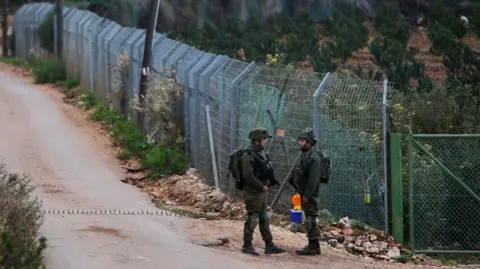
Reuters IDF soldiers guard in the norther Israeli town of Metula, on the border with Lebanon. File photoReuters
IDF soldiers guard in the norther Israeli town of Metula, on the border with Lebanon. File photo

Israel has warned it will "respond severely" after rockets were fired from Lebanon - the first since a bilateral ceasefire deal came into effect in November.

Sirens were heard in the northern Israeli town of Metula on Saturday morning and the Israel Defense Forces (IDF) said three rockets were intercepted. No injuries were reported.

No group has admitted firing the rockets. Lebanon's prime minister asked the military to take steps to prevent the country being dragged "into a new war".

IDF chief Eyal Zamir, however, said the "state of Lebanon bears responsibility" for upholding the ceasefire deal that ended 14 months of fighting with Hezbollah, the Lebanese armed group backed by Iran..

Local reports in Lebanon said artillery fire had been fired into some southern locations of the country. Israel has not confirmed.

The truce has been fragile: Israel has carried out nearly daily air strikes on what it describes as Hezbollah targets, and has indicated that attacks will continue to prevent the group from rearming.

In addition to that, the Israeli military is still occupying five locations in southern Lebanon, in what the Lebanese government says is a violation of the country's sovereignty and a breach of the ceasefire deal, which required the withdrawal of Israeli troops.

Israel says the Lebanese military has not yet fully deployed to those areas, and that it needs to remain in those points to guarantee the security of its border communities.

Saturday's rocket attack into Israel will put even more pressure on the Lebanese government, and probably be used as proof by Israel that the Lebanese army does not have full control of border areas.

Despite Israel's constant attacks, Hezbollah has not responded. The group faces the huge challenge of providing financial help to its communities affected by the war, and pressure from its opponents to disarm.

Lebanon's President Joseph Aoun, who came to power in January, has said only the state should have arms in the country, in what is seen as a reference to Hezbollah's arsenal. Lebanon's international partners say they will only help the country if the government acts to curb Hezbollah's power.

Hezbollah launched its campaign the day after the Hamas attacks on southern Israel on 7 October 2023, saying it was acting in solidarity with Palestinians in the Gaza Strip.

The longstanding conflict escalated and led to an intense Israeli air campaign across Lebanon, the assassination of Hezbollah's senior leaders and a ground invasion of southern Lebanon.

The offensive killed about 4,000 people in Lebanon - including many civilians - and led to the displacement of more than 1.2 million residents.

Israel's stated goal in its war against Hezbollah was to allow the return of about 60,000 residents who had been displaced from communities in the country's north because of the group's attacks, and to remove it from areas along the border.

Trump revokes security clearance for Harris, Clinton and others

US President Donald Trump has revoked security clearances from his previously defeated Democratic election rivals, Kamala Harris and Hillary Clinton, as well as a number of other top former officials.

The move comes after Trump said in February he was revoking security clearance for his predecessor Joe Biden. He confirmed that move in the latest announcement, adding that he was also revoking the security clearance of "any other member" of the Biden family.

"I have determined that it is no longer in the national interest for the following individuals to access classified information," Trump's memorandum read.

Former US presidents and top security officials usually keep their security clearance as a courtesy.

Former Secretary of State Antony Blinken and former Republican lawmakers Liz Cheney and Adam Kinzinger were also on the list of those who lost their security clearances - as well as Fiona Hill, a former Russian affairs adviser in the first Trump administration.

The other names were: Jake Sullivan, Lisa Monaco, Mark Zaid, Norman Eisen, Letitia James, Alvin Bragg, Andrew Weissmann and Alexander Vindman.

Trump had earlier pulled security clearances of more than four dozen former intelligence officials whom he accused of meddling in the 2020 election in Biden's favour without providing evidence.

In 2021, Biden - serving president at the time - barred his defeated rival Trump from having access to intelligence briefings citing his "erratic behaviour".

Friday, March 21, 2025

Ukraine's 'chaotic' withdrawal from Russia, in its soldiers' words

Jonathan Beale

Defence correspondent

Reporting from Sumy, Ukraine
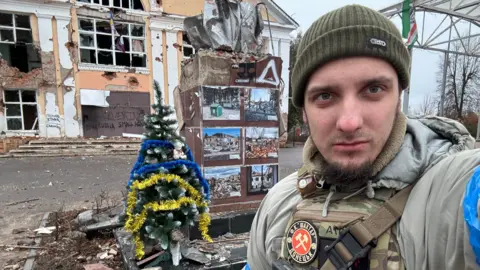
Artem Kariakin Artem KariakinArtem Kariakin
Artem and his unit would regularly cross into Russia - until last week

Until just over a week ago, Artem Kariakin and his unit were making regular trips across Ukraine's border into the Russian town of Sudzha.

He shows me video taken with a phone of their very last trip, as Ukrainian forces retreated from Russia's Kursk region. It shows them making their way past dozens of burnt out military and civilian vehicles.

A soldier armed with a shotgun, their last line of defence, scans the horizon for Russian drones. Out of nowhere, one flies towards the back of their truck. Sparks fly, but they keep on going.

Artem says they were lucky - the explosive charge was not big enough to stop them.

Another truck nearby was less fortunate. It was already in flames.

Artem admits Ukraine's retreat from Sudzha, the largest town Ukraine held in Kursk, was "not well organised".

"It was pretty chaotic," he tells me. "Many units left in disarray. I think the problem was the order to withdraw came too late."

It wasn't helped, he says, because units were operating without proper communications. The Starlink satellite systems they normally rely on didn't work inside Russia.

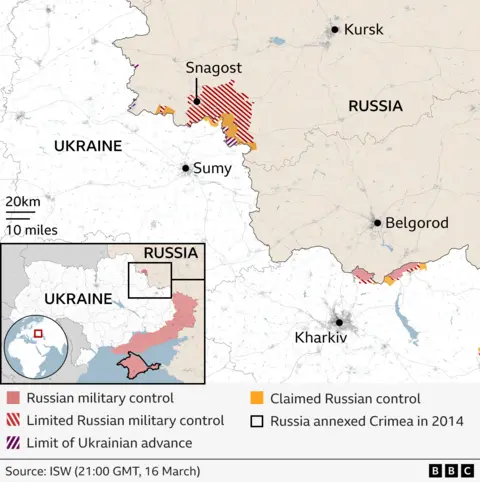
Map showing Ukrainian incursion into Russia

The 27-year-old soldier still views the Kursk offensive as broadly successful. Artem says it forced Russia to divert its forces from the east. Most of Ukraine's troops still managed to escape in time – even if for many it was on foot.

But he believes Ukraine's surprise incursion into Russian territory, launched last August, was too deep and too narrow - relying on just one main road for supplies and reinforcements.

While Artem and his men were fleeing for their lives, US President Donald Trump and Russian President Vladimir Putin were talking by phone about trying to bring the war to an end. Artem says he finds that "absurd".

"To me these calls between Trump and Putin are just surreal," he says. "Trump wants to end the war because he promised to do it - and Putin wants to deceive Trump to continue his war. I can't take their conversations seriously."

Artem, whose home is in the now Russian-occupied Luhansk region, tells me he feels disappointed with the US and Trump. "What can I feel when they just want to give away my home?"

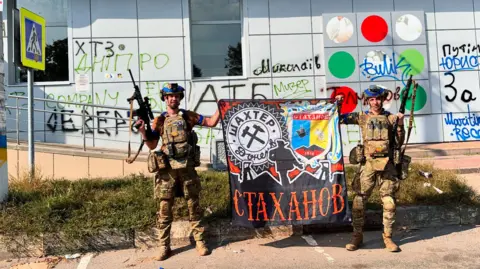
Artem Kariakin Ukrainian soldiers in SudzhaArtem Kariakin
Ukraine's incursion in August 2024 caught Russia by surprise

Artem says he never believed that Putin would be willing to trade any part of Russia for Ukraine's occupied territories. But he still believes the Kursk offensive was important to protect its own border. Ukrainian troops may have been forced to retreat, but they still occupy high ground just over the border with Sumy.

Ukraine is continuing its cross-border raids – not just into Kursk, but Belgorod too.

Serhiy's assault battalion helps plan these attacks – finding a way through Russian minefields and anti-tank obstacles known as "dragon's teeth".

We joined him on a night-time mission to locate and recover armoured vehicles in need of repairs. It's the safest time to move close to the Russian border.

Serhiy himself is no stranger to Russia: he was born there. He now has Belorussian citizenship, but he chose to fight for Ukraine. He justifies Ukraine's incursions into his former home. Russia too, he says, has been trying to create a buffer zone inside Ukrainian territory.

Travelling in his Ukrainian-made armoured vehicle, Serhiy still lists the likely threats, now we are less than 10km from the Russian border: glide bombs, rockets and artillery, and drones fitted with thermal imaging cameras.

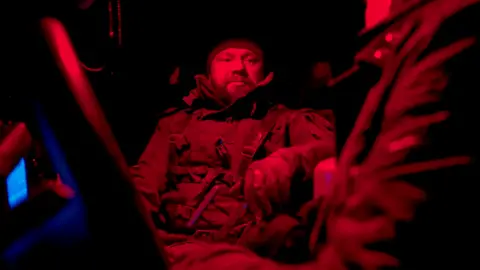
BBC/Matthew Goddard SerhiyBBC/Matthew Goddard
Serhiy fights for Ukraine against the country of his birth

His own vehicle is fitted with electronic counter-measures to jam enemy drones, but even those won't work against drones operated via fibre optic wires. Those can't be stopped, though on some routes Ukraine has now erected netting to try to catch the drones before they can hit their target.

Our original search near the Russian border for a damaged US-made Bradley armoured vehicle is abandoned when Serhiy receives intelligence that Russian drones are operating nearby. Instead, he tries to locate another broken-down Bradley where the risks will be smaller.

He and his driver still have to overcome obstacles along the way. Trees and branches lie strewn across their path – remnants from a recent Russian air strike. We see several more explosions in the distance, briefly turning the night sky orange.

Serhiy eventually finds his broken-down Bradley. It's already been retrieved from the battlefield across the border and has been loaded onto a lorry to be taken back for repairs.

The Bradley commander confirms to me that they've been fighting in Russia. He describes the situations across the border as "difficult, but we're holding on".

BBC/Matthew Goddard A soldier climbs into the back of a BradleyBBC/Matthew Goddard
The team found the Bradley, now back in Ukraine and heading for repairs

The Bradley is another reminder of Ukraine's reliance on US military support. That now seems less certain with Trump's focus on peace talks. Serhiy says it's already clear to him that there's "haggling behind Ukraine's back".

I ask Serhiy if he thinks European nations can fill any void left by the US. Is a European "coalition of the willing" enough to guarantee Ukraine's security?

"I think if America doesn't help Ukraine, then a ceasefire will be agreed soon - but on extremely unfavourable terms for Ukraine," Serhiy replies.

"Europe clearly cannot resolve this conflict alone. They're not strong enough. They've been focussing on their own economies instead of thinking about security."

Serhiy says he wants the war to end. Like many Ukrainians, he would like to see peace - but not at any price.

Additional reporting by Volodymyr Lozkho and Anastasiia Levchenko

Thursday, March 20, 2025

Iran releases French tourist held since 2022

A French tourist detained by Iranian authorities for more than two years has been released and returned to France, President Emmanuel Macron has said.

Olivier Grondeau, 34, is "free" and with his family, Macron wrote on X on Thursday, adding: "We share his family's immense happiness and relief."

Mr Grondeau was arrested in southern Iran in October 2022 and sentenced to five years in prison for "conspiracy against the Islamic republic". His family have always denied the charges.

The Iranian regime has arrested many tourists and dual nationals in recent years, mostly on spying and national security charges.

French Foreign Minister Jean-Noel Barrot posted a picture of Mr Grondeau on a plane returning home on Thursday.

"Held hostage in Iran for 887 days, he has been reunited with his family, loved ones, and his country. It's a huge relief," he wrote.

Speaking publicly for the first time since his arrest in January, Mr Grondeau said he was being "held hostage" by authorities.

His family have described him as a passionate fan of Persian poetry who had travelled to Iran on a tourist visa as part of a world tour.

Two other French citizens are currently being held in Iran.

Cecile Kohler, a teacher, and her partner, Jacques Paris, were detained in May 2022 and accused of seeking to stir up protests, which their families have denied.

There is growing concern over their health and France has repeatedly lobbied for their release.

"Cecile Kohler and Jacques Paris must be freed from Iranian prisons," Macron said in his post on Thursday.

Human rights groups say tourists and dual nationals are often held for leverage in diplomatic negotiations, released only when Iran gets something in return.

The British Foreign Office confirmed last month that a British couple - Craig and Lindsay Foreman - had been detained.

They have been charged with espionage, with Iranian state media reporting they were being held in the south-eastern city of Kerman.

In January, Italian journalist Cecilia Sala, 29, returned to Rome after spending weeks in an Iranian jail. Reports said she had been held in solitary confinement in Tehran's notorious Evin prison.

Wednesday, March 19, 2025

Istanbul mayor and Erdogan rival arrested in major crackdown

Turkish authorities have detained the mayor of Istanbul, just days before he was due to be selected as a presidential candidate.

Ekrem Imamoglu, from the secular Republican People's Party (CHP), is seen as one of Turkish President Recep Tayip Erdogan's strongest political rivals.

Prosecutors accused him of corruption and aiding a terrorist group, calling him a "criminal organisation leader suspect".

Authorities detained 100 suspects - including other politicians, journalists and businessmen - as part of the investigation, and the Istanbul governor's office has imposed four days of restrictions in the city.

Imamoglu said online that "the will of the people cannot be silenced".

In a social media video, he vowed to "stand resolute" for the people of Turkey "and all who uphold democracy and justice worldwide".

"I stand firm in my fight for the fundamental rights and freedoms," Imamoglu added.

The arrest comes as part of a major crackdown on opposition figures nationwide in recent months.

Critics have condemned the moves as politically motivated. But Erdogan - in power for 22 years - and his party have denied the claims, insisting that Turkey's judiciary is independent.

Last year, Imamoglu won a second term as Istanbul's mayor, when his CHP party swept local elections there and in Ankara.

It was the first time since Erdogan came to power that his party was defeated across the country at the ballot box.

The elections were also a personal blow to the president, who grew up in and became mayor of Istanbul on his rise to power.

Dozens of police officers were involved in the early-morning raid on Imamoglu's house in Turkey's largest city.

The CHP's presidential candidate selection, in which Imamoglu is the only person running, is set to take place on Sunday.

It came a day after Istanbul University annulled his degree due to alleged irregularities - a decision which, if upheld, would prevent him from running in presidential elections.

According to the Turkish constitution, presidents must have completed higher education to hold office.

Imamoglu called that move "legally baseless", adding that universities "must remain independent, free from political interference, and dedicated to knowledge".

His CHP party has characterised the recent interventions against him as a "coup attempt" to "prevent the nation from determining the next president".

The party's chairman, Ozgur Ozel, wrote on X that making decisions on behalf of the people, replacing their will, or using force to prevent it, amounted to a coup.

Its deputy chairman, Ilhan Uzgel, accused the government of using the detention as an "instrument to intimidate" Turkey's opposition.

He told the BBC his party was "very concerned about the state of democracy in Turkey in general".

Pro-government media outlets report that as well as being accused of extortion and fraud, Imamoglu is also alleged to have aided the PKK.

The PKK - or Kurdistan Workers' Party - has waged an insurgency since 1984, and is proscribed as a terrorist group in Turkey, the EU, UK and US.

Following Wednesday's mass detention, Istanbul's governor ordered a four-day ban on all demonstrations, meetings and press releases in Istanbul, in order to preserve "public order" and stop "possible provocative actions".

Many streets in Istanbul have also been closed to traffic, while some metro lines have also cancelled their services.

UK-based internet watchdog Netblocks reports that Turkey has severely restricted access to social media sites like X, YouTube, Instagram and TikTok following the arrests.

This is not the first time Imamoglu has faced legal issues.

In 2022, he was sentenced to more than two-and-a-half years in prison for insulting public officials in a speech.

Monday, March 17, 2025

Saakashvili handed further four years in jail

A court in Georgia has handed a further prison sentence to the jailed former president, Mikheil Saakashvili.

Saakashvili was sentenced on Monday to four-and-a-half years behind bars for illegally crossing the border when returning to the country from exile in 2021, his lawyer said.

He is already serving concurrent terms for embezzlement and abuse of power while in office, bringing his total sentence to more than 12 years.

Saakashvili has always denied wrongdoing and called his latest sentence "illegal" and "unjust". Rights groups say his imprisonment is politically motivated.

Saakashvili opposes the governing Georgian Dream party, which favours closer ties with Russia. As president, he sought to forge closer relations with Western governments.

In a video posted on X on Monday from the hospital where he is being held, Saakashvili said: "No matter what, I will fight to the end."

The former president was sentenced last week to nine years behind bars for embezzlement, running alongside the jail term he had already been serving. In 2018, he was tried in absentia and sentenced in two separate trials.

Saakashvili was arrested in 2021 after making a surprise return to Georgia ahead of the country's local elections by smuggling himself into the country on a ferry from Ukraine.

He called for mass anti-government demonstrations, but was quickly arrested by Georgian authorities.

The 57-year-old had led Georgia over two terms between 2004 and 2013. Since leaving the country, he had for the most part lived in Ukraine.

He was granted Ukrainian citizenship in 2015, renouncing his Georgian citizenship when he became governor of Ukraine's Odesa region.

His citizenship was revoked in 2017 before being restored again by President Volodymyr Zelensky in 2019.

"This [sentence] is basically sending a message... to President Zelensky, for them to scare him to show what happens when you don't surrender your country... I did not surrender Georgia," Saakashvili said in his video address while wearing a black shirt with the words "I'm Ukrainian" emblazoned on it.

Zelensky, who appointed Saakashvili to oversee reforms in Ukraine, has demanded his transfer to Kyiv.

He has previously accused Russia of "killing" Saakashvili "at the hands of the Georgian authorities".

The European Union has repeatedly called for Saakashvili's immediate release from prison, expressing concern over his deteriorating health.

The Council of Europe rights watchdog has branded him a "political prisoner," while Amnesty International has called his treatment an "apparent political revenge".

Sunday, March 16, 2025

Trump silences Voice of America as staff put on leave

Thomas Mackintosh & Merlyn Thomas

BBC News

Getty Images Sign outside of the Voice of America headquarters in Washington, DC, US, on Saturday, March 15, 2025. President Donald Trump on Friday signed an executive order aimed at reducing the scope of eight federal agencies as part of his campaign to downsize the US government, including the US Agency for Global Media, which oversees Voice of America. Getty Images
Voice of America launched in 1942 with a mandate to combat Nazi and Japanese propaganda

Donald Trump has signed an executive order to strip back the global, independent and federally funded news organisation Voice of America.

The president's order targets VOA's parent company US Agency for Global Media, or USAGM, which also funds non-profit entities such as Radio Free Europe and Radio Free Asia, which were originally set up to counter communism.

It also asks the heads of those agencies to "reduce performance… to the minimum presence and function required by law".

Mike Abramowitz, the VOA's director, said he and virtually his entire staff of 1,300 people had been put on paid leave.

Abramowitz said that the order left VOA unable to carry out its "vital mission... especially critical today, when America's adversaries, like Iran, China, and Russia, are sinking billions of dollars into creating false narratives to discredit the United States".

There has been no explanation from the Trump administration and it is not yet clear if the stations are being closed down completely.

CBS, the news partner of the BBC in the US, said that VOA employees were notified in an email by Crystal Thomas, the USAGM human resources director.

A source told CBS that all freelance workers and international contractors were told there was now no money to pay them.

Emails obtained by CBS notified the bosses of Radio Free Asia and Radio Free Europe/Radio Liberty that their federal grants had been terminated.

VOA and other stations under USAGM serve more than 400,000,000 listeners and are broadly equivalent to the BBC World Service, which is part-funded by the British government.

Elon Musk, Trump's unelected adviser who has been slashing government departments, has used his social media platform X to call for VOA to be shut down.

The US president also cut funding to several other federal agencies - including those responsible for preventing homelessness, and funding museums and libraries.

Trump was highly critical of VOA in his first term. He has recently appointed staunch loyalist Kari Lake to be a special adviser for the US Agency for Global Media.

The president regularly states that mainstream media outlets are biased against him. He called CNN and MSNBC "corrupt" and "illegal", without providing evidence, during a speech at the justice department.

Voice of America launched in 1942 which a mandate to combat Nazi and Japanese propaganda. Its first broadcast - made on a transmitter loaned to the US by the BBC - stated a modest purpose.

Gerald Ford, a former president, signed the VOA's public charter in 1976 to safeguard its editorial independence.

By 1994, the Broadcast Board of Governors, with oversight over non-military broadcasting, was established.

In 2013, a shift in legislation allowed VOA and affiliates to begin broadcasting in the US.

Friday, March 14, 2025

Power bank likely caused S Korea plane fire, investigators say

A portable power bank likely caused a fire that engulfed and destroyed a passenger plane in South Korea in January, according to local authorities.

The Air Busan plane caught fire at Gimhae International Airport in the country's south on 28 January – causing three people on board to sustain minor injuries.

On Friday, South Korea's transport ministry said that interim investigation results indicate the fire may have started because insulation inside a power bank battery had broken down.

The power bank was found in an overhead luggage compartment where the fire was first detected, and its debris had scorch marks, according to the statement.

Investigators could not say what may have caused the battery breakdown, it added.

The update is also based only on interim findings, and is not a final accident report on the aircraft, an Airbus A321ceo.

Airlines around the world have banned power banks from checked luggage for years due to safety concerns, which relate to the lithium-ion batteries inside the devices.

These batteries can produce extreme heat and fire if damage or manufacturing faults cause them to short circuit.

Lithium-ion batteries of any kind have been banned from the cargo holds of passenger planes since 2016, as per a directive by the International Civil Aviation Organisation.

In the week after the Air Busan fire, the airline tightened those rules further, announcing that it would no longer allow passengers to keep power banks in their onboard luggage.

The carrier said the new rules were in response to an increase in the number of power banks that were overheating.

A growing number of airlines – including China Airlines and Thai Airways - are rolling out similar rules, with Singapore Airlines and its low-cost unit Scoot set to become the latest to ban the use and charging of power banks onboard from 1 April.

On 28 February, the South Korean government also announced that passengers boarding flights in the country would be required to carry portable batteries and chargers on their person, rather than storing them in overhead compartments.

Thursday, March 13, 2025

Chinese hotpot chain compensates 4,000 diners after teenagers pee in soup

China's biggest hotpot chain Haidilao has offered to compensate more than 4,000 diners who visited one of its Shanghai branches, where two teens urinated into their hotpot broth.

A video of the boys peeing into their broth pot while dining in a private room was widely shared online last month. It is not clear who might have filmed the incident.

Police said the 17-year-olds, who were drunk at the time, were detained soon after the incident.

There is no suggestion anyone consumed the affected broth. Haidilao has apologised to customers, saying it has replaced all hotpot equipment and dining utensils, as well as disinfecting other crockery and utensils.

The incident happened late in February, though the company's management only found out about it days later, after videos circulated on social media.

Haidilao said the staff on duty at the time had failed to stop the teens.

It took another week to find out which outlet it was, the company said, as it has dozens of outlets in the city.

Diners in Haidilao use their own personal hotpot equipment to cook their food, and broths are not re-used again for other customers. However, it is unclear in this case if the hotpot in question was thoroughly cleaned and disinfected before it was used by the next customer.

"We fully understand that the distress caused to our customers by this incident cannot be fully compensated for by any means, but we will do our utmost to take responsibility," the company said in a statement.

Haidilao said customers who dined at the outlet between 24 February and 8 March will receive a full refund, followed by cash compensation that is 10 times the amount they were billed.

The company has expanded quickly since it opened its first restaurant in Jianyang in Sichuan province. It now operates more than 1,000 restaurants across the world.

Haidilao is known for its customer service and family-friendly atmosphere, where ladies can receive manicures and kids are treated to candy floss while waiting for a table.

Wednesday, March 12, 2025

Is Trump mulling a minerals deal with conflict-hit DR Congo?

Damian Zane

BBC News

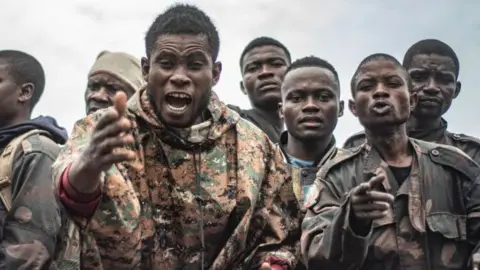
Getty Images Detained Congolese soldiers shout from a truck after they have been captured. One soldier is raising his army towards the camera.Getty Images
Congolese soldiers - some seen here after being captured by the rebels in January - have fared poorly against the M23

The Democratic Republic of Congo appears to be turning to the US in its latest efforts to find an ally in its fight against advancing M23 rebels.

Recognising that the White House of President Donald Trump is interested in transactional relationships - and seeing the proposed Ukraine-US mineral deal - the resource-rich DR Congo is hoping to strike its own agreement with Washington.

It has also been reported that Trump is soon to appoint the father-in-law of his daughter, Tiffany, to a key role in the region.

Congolese government spokesperson Patrick Muyaya confirmed to the BBC's Newsday programme that his country wanted to bring the US on board and supply it "with some critical minerals".

"Of course... we can also talk about security," he added.

Why is there talk of a deal now?

DR Congo is in trouble militarily.

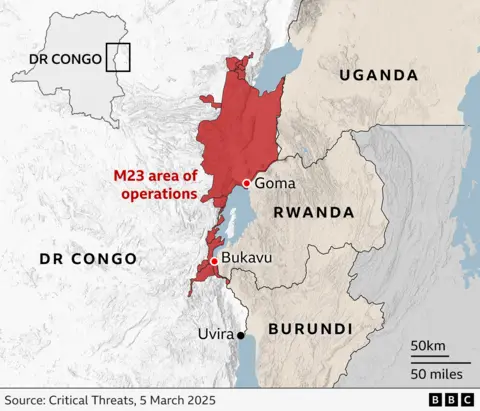
M23 fighters - backed by neighbouring Rwanda - have made major advances in parts of the mineral-rich east of the country.

Regional forces - first from east and then southern Africa - which were supposed to provide some help have failed to hold back the rebels. The M23 has talked about advancing west in a bid to seize the capital, Kinshasa, even though it is 1,600km (1,000 miles) away.

Given the dangers, it is not surprising that President Félix Tshisekedi might be looking at ways to shore up his position.

On 22 February, Tshisekedi was reported by the New York Times to have said that the Trump administration had shown interest in a deal involving strategic minerals.

The day before, the Africa-USA Business Council - a lobby group - wrote to US Secretary of State Marco Rubio on behalf of a Congolese senator describing a possible deal that included an "economic and military partnership".

What could be in it for the US?

DR Congo is estimated to have $24tn-worth (£19tn) of untapped resources - including cobalt, gold and copper.

The country is currently the world's largest supplier of cobalt - which has defence and aerospace applications as well as being essential for batteries in electric vehicles - but most of this goes to China. It also has significant lithium, tantalum and uranium deposits, which also have military uses.

Though the US is investing in a huge infrastructure project - the Lobito corridor - designed to transport goods out of central Africa to a port in Angola, its companies are not involved in mining in DR Congo.

As China dominates the Congolese mineral sector, there could be "a widening strategic gap, where adversarial nations continue to monopolise Africa's resources", the letter to Rubio said.

In theory, DR Congo could offer favourable terms to US companies to exploit the resources.

But, according to mining analyst Gregory Mthembu-Salter, as the US, unlike China, relies on private commercial companies to do the work, they may decide that it is too risky to do business there.

But this is all highly speculative and a US Department of State spokesperson said that there was "nothing to preview or announce at this time".

Nevertheless, the US "is open to discussing partnerships in this sector" that align with the executive order aimed at making the US a "leading producer and processor of non-fuel minerals, including rare earth minerals".

How could the DR Congo benefit?

One key area could be in "strengthening military co-operation", as the letter to Rubio puts it.

This would involve:

  • Training and equipping soldiers "to protect mineral supply routes"
  • Giving the US access to military bases "to protect strategic resources"
  • And "replacing ineffective UN peacekeeping operations with direct US-DRC security co-operation".

The Congolese spokesperson declined to confirm these details, but there is some scepticism about how realistic and immediately effective they could be.

According to Stephanie Wolters, regional analyst for the South African Institute of International Affairs, if Kinshasa wants a US military presence in the east then "that is not very likely to happen".

Furthermore, "weapons and training are longer-term issues", she told BBC Focus on Africa.

"I think the outreach the Congolese government has made is surely because of the active military situation in the east and I'm not convinced that what the US might offer in return is really something that can address the acute need at the moment."

Congolese mining industry analyst Jean-Pierre Okenda said some oversight of the deal would be wise, suggesting parliament and civil society should also be consulted if it was going to serve the interests of the people.

Looking at the bigger picture, he said that moves towards a more peaceful future need to address the "kleptocratic management of the state".

A previous deal with China that gave access to minerals in exchange for infrastructure projects was criticised for not delivering on some of what was promised.

Tshisekedi has since renegotiated this, but the lack of transparency in those talks has been criticised.

What next?

Nothing concrete is likely to happen soon.

While Muyaya, speaking for Kinshasa, was vague on what we could expect, he told the BBC that "in the coming days we can have more details to share".

He added that there was "the political will [from Tshisekedi] and I think the US has attention on those questions".

On the US side, according to the news website Semafor, President Trump is due to announce that Massad Boulos will be the White House's new Great Lakes regional envoy.

He is the father of Michael Boulos, who is married to Trump's daughter Tiffany, and has been serving as Trump's senior adviser on Arab and Middle Eastern affairs since December.

Among his business interests is a Nigeria-based company that specialises in the distribution of motor vehicles and equipment across West Africa - and he is expected to fly to Kinshasa at some point in the next few weeks.

Map showing areas under M23 control

More about the conflict in DR Congo:

Getty Images/BBC A woman looking at her mobile phone and the graphic BBC News AfricaGetty Images/BBC
BBC Africa podcasts

Monday, March 10, 2025

Explosive-laden caravan plot was a hoax, say Australian police

A caravan found packed with explosives in outer Sydney earlier this year was part of a "fabricated terrorism plot" concocted by criminals, Australian police have said.

The caravan, which was found in northwestern Sydney on 19 January, contained enough explosives to produce a 40m-wide blast, along with a note displaying antisemitic messages and a list of Jewish synagogues.

Its discovery, following a spate of antisemitic attacks in Australia, triggered widespread panic.

But on Monday, Australian Federal Police (AFP) revealed that they knew "almost immediately" that the caravan was "essentially a criminal con job".

AFP's deputy commissioner of national security, Krissy Barrett, said investigators within the New South Wales Joint Counter Terrorism Team believed that the caravan was "part of a fabricated terrorism plot".

Authorities arrived at that belief based on information they already had, the ease with which they found the caravan and the visibility of the explosives contained inside – as well as the fact that there was no detonator.

Yet police refrained from telling the public that they believed the plot was fake "out of an abundance of caution", as they continued to receive tip-offs about other related terror plots. They are now confident that these tip-offs were also fabricated, Ms Barrett said.

The fake caravan plot involved several people with different levels of involvement, according to police. Between them, they had planned to purchase a caravan, load it with explosives and antisemitic materials and leave it in a specific location, before informing law enforcement about "an impending terror attack against Jewish Australians".

Ms Barrett described it as "an elaborate scheme contrived by organised criminals, domestically and from offshore", adding that the leader of the plot maintained a distance and hired alleged local criminals to carry out parts of the operation.

Police confirmed that individual has not been arrested.

"Too many criminals are accused of paying others to carry out antisemitic or terrorism incidents to get our attention or divert our resources," Ms Barrett said. She also noted that police believe "the person pulling the strings wanted changes to their criminal status".

Ms Barrett cited the case of another individual who allegedly tried to procure high-powered weapons for a fake terror plot so he could provide information to authorities in exchange for a reduction to his sentence.

BBC News has contacted AFP for more details on the suspected agenda of those behind the caravan hoax, but received no further comment.

"Regardless of the motivation of those responsible for this fake plot, this has had a chilling effect on the Jewish community," Ms Barrett said in her statement.

"What organised crime has done to the Jewish community is reprehensible, and it won't go without consequence. There was also unwarranted suspicion directed at other communities – and that is also reprehensible."

Separately, New South Wales police arrested 14 people on Monday morning as part of Strike Force Pearl: a police operation established in December 2024 to investigate antisemitic hate crimes across Sydney.

The establishment of the Strike Force followed a string of antisemitic attacks in Australia in late-2024, including the vandalism of a Jewish school in Sydney's eastern suburbs and the arson of a childcare centre, which was set alight and sprayed with antisemitic messages.

Sunday, March 9, 2025

Mass blackouts in storm-hit eastern Australia

Getty Images Residents in the Brisbane suburb of Newmarket carry umbrellas and stand on dry ground next to a flooded part of the roadGetty Images
Residents in the Brisbane suburb of Newmarket on their flooded street

Hundreds of thousands of people remain without power in Australia after a cyclone brought wild weather to the east coast.

Communities in southeast Queensland and northern New South Wales (NSW) were beginning the clean-up on Sunday after the storm caused widespread flooding and knocked down power lines and trees.

A 61-year-old man's body was recovered from floodwaters on Saturday, while in a separate incident, 12 soldiers were taken to hospital after their convoy crashed en route to rescue operations.

The storm had weakened by the time it made landfall near Brisbane on Saturday night, but Prime Minister Anthony Albanese on Sunday warned locals of the continued wild weather and risks from flooding.

"The situation in Queensland and northern New South Wales remains very serious due to flash flooding and heavy winds," Albanese said.

"Heavy rainfall, damaging wind gusts and coastal surf impacts are expected to continue over coming days."

Reuters The Australian prime minister delivering a briefing in front of a screen showing weather warnings for the country's east coastReuters
Prime Minister Anthony Albanese has warned of more heavy rain to come

Cyclone Alfred had hovered for days off the country's east coast as a category two cyclone before weakening into a tropical depression on Saturday.

By Sunday evening, emergency services had conducted over a dozen rescues in Queensland and NSW - most involving people trapped by rising waters in their cars or homes. The NSW State Emergency Service reported receiving more than 6,000 calls for help.

Almost 290,000 properties in the affected regions remain without power, and energy companies have warned residents the blackouts could persist for days.

Getty Images Brown floodwater swamps a main road in Lismore, with the water reaching metres high up buildings and treesGetty Images
The flooding seen in the northern New South Wales town of Lismore on Sunday
Reuters A damaged and eroded foreshore of a beach is seen on the Gold Coast following heavy rains and winds caused by Cyclone AlfredReuters
The storm eroded sections of the beach on the Gold Coast

Police said on Saturday they had discovered a body in the search for a 61-year-old man who went missing on Friday after his car was caught in floodwaters in Dorrigo, northern NSW.

Emergency responders witnessed the man escaping his car and climbing onto a tree near the riverbank, but rescuers were not able to reach him before he was swept away.

In a separate incident on Saturday, 12 soldiers were injured in a convoy crash in Lismore, about 200km south of Brisbane, as they were on their way to rescue and recovery efforts.

The soldiers were still in hospital on Sunday, two of them in a serious condition, New South Wales Premier Chris Minns told a news conference.

"We wish a speedy recovery for all of those young soldiers," he said.

Queensland's police authorities said they had not recorded any fatalities or missing people in the state so far as a result of the weather event.

The BBCs Katy Watson reports from the Gold Coast, as strong winds and heavy rains batter the region

Saturday, March 8, 2025

Vital leprosy drugs due in Nigeria after year delay

People affected by leprosy in Nigeria should be able to get hold of vital drugs to treat the disease for the first time in a year from this weekend, the World Health Organization has said.

The country, which reports more than 2,000 new cases a year ran out of supplies partly because drugs were held up after new regulations were introduced.

The WHO said it had asked Nigeria to briefly lift its new testing policy and it expects the drugs to arrive from India on Sunday.

Leprosy is curable with a combination of different antibiotics, but if left untreated the patients' health can deteriorate with sores and nerve damage that cause deformities.

The treatment can last between six and 12 months.

But because of the lack of drugs in Nigeria, patients have been sent home from hospitals. As the drugs suppress transmission this increases the risk of the disease spreading.

Dr Samimu Msheliza, a public health expert and medical advisor at the Nigerian branch of the Leprosy Mission, highlighted the urgent need for medication.

"We have thousands of newly diagnosed leprosy patients across various cities who are just waiting for this drug," he told the BBC.

"The quicker we have [the drugs], the better, because currently these people are suffering, their transmission is ongoing because they are not being treated," Dr Msheliza said.

The Reuters news agency spoke to one woman at a hospital in Nasarawa state, who said her condition had got much worse since she was not able to get hold of the combination of drugs.

All Awwal Musa's fingers were clawed and her legs discharged pus. "Before last year, my wounds were getting healed but now they are getting worse. The pain is worse," Ms Musa is quoted as saying.

The nerve damage may be irreversible.

Nigeria's drug authority introduced new regulations for medicines aimed at tackling the importation of counterfeit and sub-standard drugs.

In recent years, several medicines have been recalled for failing to meet safety standards.

But the new measures have had an impact on the availability of crucial treatments, including those for leprosy.

Tuesday, March 4, 2025

What pause in US military aid could mean for Ukraine

President Donald Trump's decision to pause all US aid to Ukraine is a bitter blow – not just for Kyiv but also European allies who have been lobbying the US administration to continue its support.

This is not the first time that the US has withheld military aid. Republicans in Congress blocked then-President Joe Biden's largest tranche of military assistance for Ukraine in the summer of 2023.

Then, Ukraine just about managed to eke out its existing stocks of ammunition with the help of Europe.

Congress finally approved the £60bn aid package in the spring of 2024. It was just in time - Ukraine was struggling to fend off a renewed Russian offensive in Kharkiv. The arrival of the delayed US weapons helped turn the tide.

As in 2024, it may be months before the effects of cutting off US aid are felt – at least in terms of ammunition and hardware. European nations have slowly ramped up their production of artillery shells. Overall Europe now provides Ukraine with 60 percent of its aid – more than the US.

However, US military support is still vital to Ukraine. One Western official recently described it as "the cream" in terms of weapons.

Ukraine's ability to protect its people and cities has heavily relied on sophisticated US air defence systems – such as Patriot batteries and NASAMS – jointly developed with Norway.

The US has given Ukraine the ability to carry out long range strikes – with HIMARS and ATACM missiles. The US has limited their use inside Russia, but they have still been vital to hit high value targets inside occupied territories.

It is not just quality, but quantity too. As the world's most powerful military, it has been able to send hundreds of surplus Humvees and armoured vehicles - numbers that smaller European armies could never match.

The absence of some of this aid may take time to filter down to the frontline. But there could be a more worrying immediate impact, not least in terms of intelligence sharing.

No nation can match the US in terms of space-based surveillance, intelligence gathering and communications. And it is not just provided by the US military, but commercial companies too.

Take Elon Musk's Starlink satellite communication network. Every Ukrainian position I have visited on the frontline has a Starlink dish.

They are used to relay the latest information on the battlefield. They have been essential to co-ordinate artillery and drone strikes.

In the past, the Pentagon has admitted that it has been funding this lifeline. Given that Elon Musk is a key figure in the US administration, it seems highly unlikely that he will now be willing to foot the bill. He too is a harsh critic of Ukrainian President Volodymyr Zelensky.

Will the US prevent European countries from sending their US-made equipment to Ukraine? When Europe wanted to provide US-manufactured F-16 jets to Ukraine, it first had to receive the approval of Washington.

And then what about the maintenance of US-supplied equipment? The US has also been training Ukrainian forces and then helping them maintain US-supplied equipment.

Biden lifted restrictions on US contractors working in Ukraine towards the end of his term. F-16 jets in particular need engineers and spares to keep on running.

Trump's decision to pause aid may, to many in Ukraine and beyond, seem petulant. But there is also clearly a political aim to force them to the negotiating table sooner.

The hope among European allies is that it will just be a pause. Without US support, Ukraine will find it an even harsher struggle for survival.

Sunday, March 2, 2025

Private spacecraft Blue Ghost lands on Moon

George Sandeman

BBC News

Watch: Celebrations as Luna lander touches down on Moon

A private spacecraft has landed on the Moon, becoming only the second commercial vehicle to reach the lunar surface.

Blue Ghost left Earth on January 15, after being launched by US firm Firefly Aerospace with the intention of exploring the Sea of Crises, a huge crater visible from Earth.

The project is the latest collaboration by US space agency Nasa and private companies.

Intuitive Machines, another firm, is hoping to land its Athena spacecraft near the Moon's south pole in the next few days.

Intuitive was the first private company to achieve a lunar landing. Its spacecraft Odysseus reached the Moon on 22 February last year.

However, the mission was short-lived as the spacecraft landed on the slope of a crater, broke some landing gear and toppled over.

Blue Ghost touched down smoothly, having been orbiting the Moon for the last two weeks.

Staff at Firefly's headquarters in Texas broke out into cheering and applause when they were told their landing was successful.

Reuters The Moon passes underneath the Blue Ghost spacecraft on 24 February 2025 as it orbits the lunar surface ahead of its landing on 2 March 2025. The gold foil underneath the spacecraft is visible, below is the cratered gray surface of the moon and the blackness of space is in the background. Reuters
Blue Ghost orbiting the Moon in the week before it landed on the lunar surface

Dr Simeon Barber, a planetary science researcher from the Open University, said Blue Ghost was essentially the first successful private venture to the Moon, as the vehicle was intact and responsive.

He told BBC Breakfast: "[They've] demonstrated a technology for landing on the surface of the Moon, the kind that had been forgotten after the Apollo era when we had astronauts on the [lunar] surface."

The importance of the Moon to many private firms, said Dr Barber, was to use it as a launch pad for exploring the rest of space.

"By going to the Moon, we can learn how to run robotic instruments in space [and] in the really harsh environment of the Moon, which is at times hot and at times cold. It's very dusty, there's lots of radiation."

Getty Images The Blue Ghost spacecraft photographed at Firefly Aerospace's headquarters in Texas. The square probe looks at least two metres tall and has legs protruding out at an angle. The body is covered in gold foil and has logos for Nasa and Firefly.Getty Images
Blue Ghost is the latest collaboration between Nasa and private firms who want to explore space
Reuters The cratered surface of the Moon seen under the Blue Ghost spaceship as it orbits the lunar surface. The gold foiled legs of the spacecraft can be seen above the Moon.Reuters
Blue Ghost's mission is to explore the Sea of Crises – a huge crater visible from Earth

He said at some point it was likely humans would return to the lunar surface and explained it had been so long because of a lack of funding.

The last time humans set foot on the Moon was 19 December 1972, during the Apollo 17 mission.

"The Apollo missions were hugely successful," explained Dr Barber. "But they were 'touch and go' missions."

Back then, astronauts would be there for three days before having to leave again, as costs were running into the billions of dollars. "That's not sustainable," he said.

Allow Twitter content?

This article contains content provided by Twitter. We ask for your permission before anything is loaded, as they may be using cookies and other technologies. You may want to read  and  before accepting. To view this content choose ‘accept and continue’.

Dr Barber said the belief now was that bringing private companies into the fold would help reduce costs as a result of commercial competition.

It could lead to cheaper landers and innovations that might extract resources from the moon, such as water for the astronauts to drink.

The first private company to attempt to reach the moon was another US firm, Astrobotic Technology.

They tried reaching the moon in January 2024, but their lander never made it to the moon, because of a suspected fuel leak, and crashed back to Earth.

The fiery descent meant the spacecraft broke apart in its final moments before plunging into the southern Pacific Ocean.

More on this story

Pro-Ukraine protests across US after Trump-Zelensky clash

Pro-Ukraine protests have taken place across the US after Donald Trump and JD Vance's angry exchange with Volodymr Zelensky at the White House.

Hundreds of people gathered in New York, Los Angeles and Boston to express their support for Ukraine after the furious row in the Oval Office.

Protesters holding pro-Ukraine signs also lined a road in Waitsfield, Vermont, where Vice-President Vance and his family were visiting for a ski holiday.

US media reported the family moved to an undisclosed location from their planned ski resort because of the demonstrations.

A protest in Waitsfield against the Trump-Vance administration had been organised earlier in the week - before the US president and vice-president's clash with Zelensky - but many signs referenced the row and Russia's war with Ukraine.

"I think [Friday's] performance at the White House has probably galvanised even more people to come out today," Judy Daly, from Indivisible Mad River Valley, the group which organised the protest, told Vermont Public Radio.

"[Vance] crossed the line," protester Cori Giroux added.

Ahead of the Vance family's trip, Vermont's governor Phil Scott had urged people to "be respectful" to them.

Scott, the Republican governor who refused to vote for Trump, said: "I welcome the vice-president and his family to Vermont and hope they enjoy their weekend here.

"It's no surprise they chose Vermont, we've had a lot of snow this winter, which has been good for our economy."

He added: "I hope Vermonters remember the vice-president is here on a family trip with his young children and, while we may not always agree, we should be respectful.

"Please join me in welcoming them to Vermont, and hoping they have an opportunity to experience what makes our state, and Vermonters, so special."

Vance, who has three young children with his wife Usha, has not publicly commented on the protests. Counter-protesters supporting Trump and Vance were also reportedly in Waitsfield.

Demonstrators also gathered outside Tesla stores across the US on Saturday to protest against Elon Musk's push to slash government spending.

Musk, the billionaire chief executive of Tesla, has been tasked by Trump to oversee the Department of Government Efficiency, more popularly known as Doge.

In extraordinary scenes in the Oval Office on Friday, Trump clashed with Zelensky, telling him to make a deal with Russia "or we are out".

At one point, Trump told Zelensky he was not thankful enough for US military and political support during Ukraine's fight against Russia's invasion, and that he was "gambling with World War Three".

Vance also accused the Ukrainian president of being disrespectful and "litigating" the situation in front of the media.

Zelensky will join European leaders on Sunday for a summit on the Ukraine war, hosted by UK Prime Minister Sir Keir Starmer.

Ahead of the meeting in London, UK Chancellor Rachel Reeves signed a loan agreement worth £2.26bn ($2.84bn) with her Ukrainian counterpart, to pay for further military support and the rebuilding of Ukraine in future.

 
Khám phá thêm + Cho Dien Tu + Mua Hang Online Uy Tin + Mua Hang Online + Nguoi Noi Tieng + Nguoi Dep Viet Nam + Idol Viet Nam + Nghe Si Viet + Tin Tuc Sao Viet + Thuong Hieu Ca Nhan + Nguoi Noi Tieng Phim + Kiem Tien Tren Mang + Han Duc Hai + Dang Rao Vat + Trang Rao Vat
Phu Kien Dien Thoai